


If you need help studying for the LSAT® or just want some more information about what the test is like, you’ve come to the right place.
Click below to take a free LSAT practice test!



What's on the LSAT?
How to Register
LSAT Scores
Retaking the LSAT
FAQs
Subject-Specific Practice Tests
If you need some extra practice in a specific subject, click one of the subjects below to get started on a subject-specific LSAT practice test.

What's on the LSAT?
The LSAT is a fully digital exam consisting of four multiple-choice sections plus a separate writing sample. Each multiple-choice section is 35 minutes long, for a total testing time of 2 hours and 20 minutes (not including breaks).
Experimental Section
One of the multiple-choice sections is experimental, which means the questions in that section will not count toward your score. This section may be Logical Reasoning or Reading Comprehension.
Here's the trick: You won't know which section of the test is the experimental section.
This means you'll need to go through every section of the test as if it's being scored.
Test Outline
Now, let's take a closer look at the different sections of the LSAT.
Writing
1 argumentative essay
Reading Comprehension
35 minutes
Logical Reasoning
35 minutes per section (2 sections)
How to Register
To get started with the registration process, you’ll need to create an account on the LSAC website. Registration allows you to select your test date, testing format (remote or in-person), and submit payment.

Online LSAT Prep Course
If you want to be fully prepared, Mometrix offers an online LSAT Prep Course. The course is designed to provide you with any and every resource you might want while studying. The LSAT Course includes:
- 30+ Review Lessons Covering Every Topic
- Over 600 LSAT Practice Questions
- 250+ Digital Flashcards
- Money-back Guarantee
- Mobile Access
The LSAT Prep Course is designed to help any learner get everything they need to prepare for their LSAT exam. Click below to check it out!
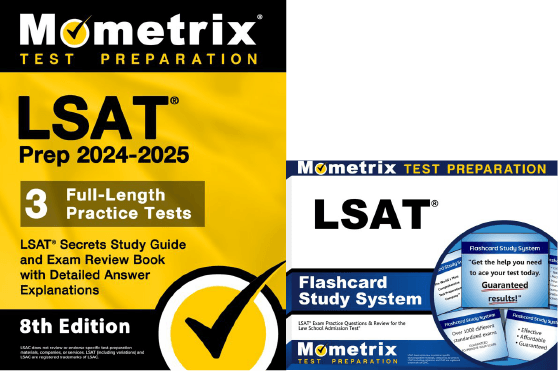
LSAT Study Guide and Flashcards
Get practice questions, detailed study lessons, and complex subjects broken down into easily understandable concepts.
How is the LSAT Scored?
The test is scored using a scaled scoring method. Here’s how it works:
For every question you answer correctly, you get one point added to your raw score. At the end of the test, your final raw score will be converted to a scaled score. This scaled score will range somewhere between 120 and 180.
The reason your raw score is converted to a scaled score is because everyone who takes the LSAT is given a slightly different set of questions. Since everyone has a different arrangement of questions, and because some questions are harder than others, converting your raw score to a scaled score ensures a more even playing field.
Retaking the LSAT
If you didn't get the score you wanted on your first try, that's okay! You can retake the LSAT three times in a testing year and up to seven times in your lifetime.
FAQs
How long is the LSAT?
The multiple-choice portion is 2 hours and 20 minutes. The Argumentative Writing section is completed separately and is not timed as part of the multiple-choice exam.
What is a good LSAT score?
A “good” score will differ depending on which school you’re trying to get into. However, a generally good score to aim for is 150-160.
How many times can you take the LSAT?
You can take the LSAT up to three times in a single testing year, five times within five years, and seven times total over your lifetime.
How hard is the LSAT?
The LSAT is a very competitive exam that focuses heavily on logical reasoning, critical reading, and argument analysis. Success depends less on memorization and more on your ability to think analytically under time pressure.
LSAC does not review or endorse specific test-preparation materials, companies, or services. LSAT (including variations) and LSAC are registered trademarks of LSAC.