
- A circle has a radius of 7 cm. What is its circumference? Use \(\pi \approx 3.14\).
- 21.98 cm
- 43.96 cm
- 153.86 cm
- 49 cm
The circumference of a circle is given by:
\(C = 2\pi r\)
Substitute \(r = 7\):
\(C = 2\pi(7) = 14\pi \approx 14(3.14) = 43.96 \text{ cm}\)
Choice A uses the formula \(\pi r\) (forgetting the factor of 2). Choice C gives the area of the circle (\(\pi r^2\)) instead of the circumference.
- A circle has a diameter of 10 inches. What is its area? Leave your answer in terms of \(\pi\).
- \(25\pi\) in²
- \(100\pi\) in²
- \(10\pi\) in²
- \(20\pi\) in²
The area formula uses the radius, not the diameter. First, find the radius by dividing the diameter by 2:
\(r = \dfrac{10}{2} = 5 \text{ inches}\)
Now apply the area formula:
\(A = \pi r^2 = \pi(5)^2 = 25\pi \text{ in}^2\)
Choice B uses the diameter (10) as the radius in the formula, giving \(\pi(10)^2 = 100\pi\). Always convert diameter to radius before using the area formula.
- The area of a circle is \(81\pi\) cm². What is the radius?
- 9 cm
- 18 cm
- 40.5 cm
- \(\sqrt{81}\pi\) cm
Start with the area formula and solve for the radius:
\(\pi r^2 = 81\pi\)
Divide both sides by \(\pi\):
\(r^2 = 81\)
Take the square root of both sides:
\(r = 9 \text{ cm}\)
Choice B gives the diameter, not the radius. Always check whether a question is asking for radius or diameter.
- What is the length of an arc subtended by a central angle of 60° in a circle with radius 12 cm? Leave your answer in terms of \(\pi\).
- \(2\pi\) cm
- \(4\pi\) cm
- \(6\pi\) cm
- \(12\pi\) cm
The arc length formula relates the central angle to the full circumference:
\(s = \dfrac{\theta}{360°} \cdot 2\pi r\)
Substitute \(\theta = 60°\) and \(r = 12\):
\(s = \dfrac{60°}{360°} \cdot 2\pi(12) = \dfrac{1}{6} \cdot 24\pi = 4\pi \text{ cm}\)
The central angle is \(\frac{1}{6}\) of a full 360° rotation, so the arc is \(\frac{1}{6}\) of the full circumference.
- What is the area of a sector with a central angle of 90° in a circle with radius 6 cm? Leave your answer in terms of \(\pi\).
- \(9\pi\) cm²
- \(12\pi\) cm²
- \(18\pi\) cm²
- \(36\pi\) cm²
The area of a sector is a fraction of the full circle’s area, based on the central angle:
\(A_{\text{sector}} = \dfrac{\theta}{360°} \cdot \pi r^2\)
Substitute \(\theta = 90°\) and \(r = 6\):
\(A = \dfrac{90°}{360°} \cdot \pi(6)^2 = \dfrac{1}{4} \cdot 36\pi = 9\pi \text{ cm}^2\)
A 90° sector is exactly \(\frac{1}{4}\) of the circle (a quarter circle). Choice D gives the area of the entire circle.
- What is the equation of a circle with center \((2, -3)\) and radius 5?
- \((x – 2)^2 + (y + 3)^2 = 25\)
- \((x + 2)^2 + (y – 3)^2 = 25\)
- \((x – 2)^2 + (y + 3)^2 = 5\)
- \((x + 2)^2 + (y – 3)^2 = 5\)
The standard form of a circle’s equation is:
\((x – h)^2 + (y – k)^2 = r^2\)
where \((h, k)\) is the center and \(r\) is the radius. Substitute \(h = 2\), \(k = -3\), and \(r = 5\):
\((x – 2)^2 + (y – (-3))^2 = 5^2\)
\((x – 2)^2 + (y + 3)^2 = 25\)
Be careful with signs: subtracting \(-3\) becomes \(+3\). Also, the right side is \(r^2\), not \(r\), so 5 becomes 25 (choice C makes this mistake).
- What are the center and radius of the circle given by the following equation?
- Center \((-4, 1)\), radius 7
- Center \((4, -1)\), radius 7
- Center \((-4, 1)\), radius 49
- Center \((4, 1)\), radius 7
Compare the given equation to the standard form \((x – h)^2 + (y – k)^2 = r^2\):
- \((x + 4)^2 = (x – (-4))^2\), so \(h = -4\)
- \((y – 1)^2\), so \(k = 1\)
- \(r^2 = 49\), so \(r = 7\)
The center is \((-4, 1)\) and the radius is 7. Choice B flips both signs of the center. Choice C fails to take the square root, giving \(r = 49\) instead of 7.
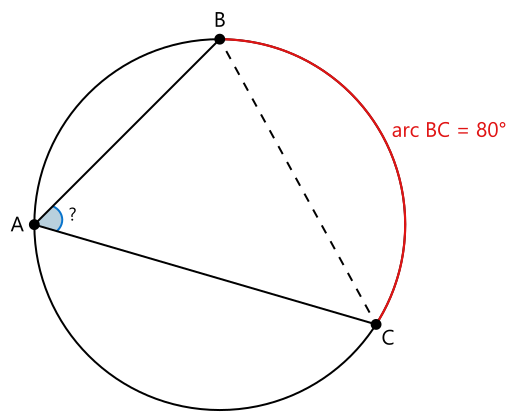
- An inscribed angle in a circle intercepts an arc of 80°. What is the measure of the inscribed angle?
- 40°
- 80°
- 160°
- 100°
The inscribed angle theorem states that an inscribed angle is half the measure of its intercepted arc:
\(\text{inscribed angle} = \dfrac{1}{2} \cdot \text{arc}\)
Substitute 80° for the arc:
\(\dfrac{1}{2}(80°) = 40°\)
Remember: An inscribed angle has its vertex on the circle, while a central angle has its vertex at the center. A central angle equals its intercepted arc, but an inscribed angle equals half its intercepted arc.
- A chord is drawn from a point on a circle to a diameter, creating an inscribed angle with the diameter as one side. What is the measure of this inscribed angle?
- 45°
- 60°
- 90°
- It depends on where the point is located.
This is known as Thales’ Theorem: An inscribed angle that intercepts a diameter is always a right angle (90°), regardless of where the third point is located on the circle.
This follows from the inscribed angle theorem. A diameter intercepts an arc of 180° (a semicircle), so the inscribed angle is:
\(\dfrac{1}{2}(180°) = 90°\)
This property is useful in many geometry problems. Any triangle inscribed in a semicircle with the diameter as one side is automatically a right triangle.
- A tangent line touches a circle at exactly one point. What is the measure of the angle between the tangent line and the radius drawn to the point of tangency?
- 45°
- 60°
- 90°
- 180°
A fundamental property of circles: a tangent line is always perpendicular to the radius drawn to the point of tangency. So the angle between them is 90°.
This property is useful in many problems involving tangent lines. For example, if a triangle is formed by a tangent segment, a radius, and a line from the external point to the center, it is always a right triangle with the right angle at the point of tangency.
- Convert the following equation to standard form and find the center of the circle.
- \((3, -2)\)
- \((-3, 2)\)
- \((6, -4)\)
- \((-6, 4)\)
Complete the square for both \(x\) and \(y\) to convert to standard form. Start by grouping the \(x\) and \(y\) terms:
\((x^2 – 6x) + (y^2 + 4y) = 12\)
For \(x^2 – 6x\), take half of −6 (which is −3), square it (9), and add:
\((x^2 – 6x + 9) = (x – 3)^2\)
For \(y^2 + 4y\), take half of 4 (which is 2), square it (4), and add:
\((y^2 + 4y + 4) = (y + 2)^2\)
Add the same values to the right side to keep the equation balanced:
\((x – 3)^2 + (y + 2)^2 = 12 + 9 + 4 = 25\)
The center is \((3, -2)\) and the radius is \(\sqrt{25} = 5\).
- A circle is inscribed in a square with side length 8 cm. What is the area of the circle? Leave your answer in terms of \(\pi\).
- \(16\pi\) cm²
- \(32\pi\) cm²
- \(64\pi\) cm²
- \(8\pi\) cm²
When a circle is inscribed in a square, the diameter of the circle equals the side length of the square. So:
\(d = 8 \text{ cm} \implies r = 4 \text{ cm}\)
Apply the area formula:
\(A = \pi r^2 = \pi(4)^2 = 16\pi \text{ cm}^2\)
Choice C uses the side length (8) as the radius instead of the diameter.
- A circle has a circumference of \(18\pi\) cm. What is the area of the circle? Leave your answer in terms of \(\pi\).
- \(81\pi\) cm²
- \(324\pi\) cm²
- \(9\pi\) cm²
- \(36\pi\) cm²
First, find the radius using the circumference formula:
\(C = 2\pi r \implies 18\pi = 2\pi r \implies r = 9 \text{ cm}\)
Now use the radius to find the area:
\(A = \pi r^2 = \pi(9)^2 = 81\pi \text{ cm}^2\)
Choice B would result from using \(r = 18\) directly instead of solving for \(r\) first.
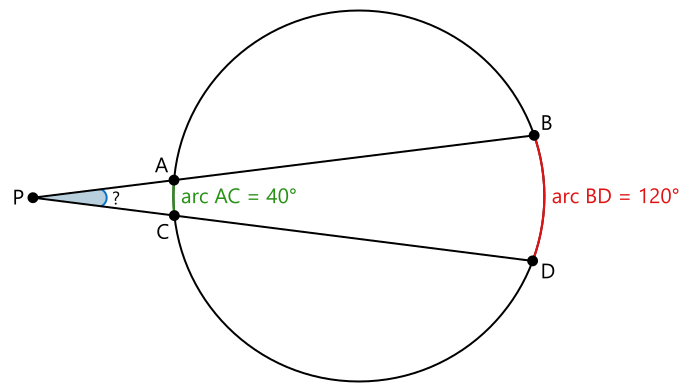
- Two secants are drawn from an external point to a circle. If one secant creates an arc of 120° and the other creates an arc of 40° (the two arcs intercepted by the secants), what is the measure of the angle formed at the external point?
- 40°
- 60°
- 80°
- 160°
When two secants meet at a point outside the circle, the angle formed equals half the difference of the intercepted arcs:
\(\text{angle} = \dfrac{1}{2}|\text{far arc} – \text{near arc}|\)
Substitute the two arcs:
\(\dfrac{1}{2}(120° – 40°) = \dfrac{1}{2}(80°) = 40°\)
Contrast this with angles formed inside the circle (intersecting chords), which equal half the sum of the intercepted arcs.
- A circle has center \((0, 0)\) and radius 5. Does the point \((3, 4)\) lie inside the circle, on the circle, or outside the circle?
- Inside the circle
- On the circle
- Outside the circle
- Cannot be determined
Calculate the distance from the point \((3, 4)\) to the center \((0, 0)\) using the distance formula:
\(d = \sqrt{(3 – 0)^2 + (4 – 0)^2} = \sqrt{9 + 16} = \sqrt{25} = 5\)
Since the distance equals the radius, the point lies on the circle. In general:
- If \(d \lt r\), the point is inside the circle.
- If \(d = r\), the point is on the circle.
- If \(d \gt r\), the point is outside the circle.
You can also verify by plugging \((3, 4)\) into the circle’s equation:
\(x^2 + y^2 = 25 \implies 9 + 16 = 25\)