
- What are the three main layers of Earth?
- Crust, mantle, and core
- Inner core, outer core, and mantle
- Lithosphere, asthenosphere, and mesosphere
- Continental crust, oceanic crust, and core
Earth has three main layers: the crust (solid rock outermost layer), the mantle (hot rock below the crust), and the core (the center made of iron and nickel).
- What is the difference between magma and lava?
- Magma is cooler than lava.
- Magma is underground, while lava is on the surface.
- Lava is found only in shield volcanoes.
- Magma is solid rock, while lava is liquid rock.
Magma is molten rock beneath Earth’s surface. When it erupts through a volcano or fissure, it becomes lava. The terms distinguish location, not composition.
- Which type of rock forms from the cooling of magma or lava?
- Sedimentary rock
- Metamorphic rock
- Igneous rock
- Fossilized rock
Igneous rock forms when magma or lava cools and solidifies. If cooling happens quickly at Earth’s surface, it forms fine-grained basalt; slow cooling below the surface creates coarse-grained granite.
- What is plate tectonics?
- The study of fossils in rock layers
- The process of mineral formation underground
- The theory that continents move
- The theory of moving crustal plates
Plate tectonics is the theory that Earth’s outer layer consists of moving plates that interact at their boundaries, causing earthquakes, volcanoes, and mountain formation.
- What are the stages of the rock cycle?
- Melting, cooling, compression, and erosion
- Weathering, deposition, cementation, and folding
- Formation, destruction, and reformation
- Crystallization, sedimentation, and metamorphosis
The rock cycle involves melting (rock becomes magma), cooling (magma forms igneous rock), compression (pressure and heat form metamorphic rock), and erosion (weathering produces sediment for new sedimentary rocks).
- What is the primary cause of earthquakes?
- The sudden movement of water underground
- Energy release from moving tectonic plates
- Extreme weather conditions in the atmosphere
- The rotation of Earth on its axis
Earthquakes occur when tectonic plates move and suddenly release stored energy, causing seismic waves to travel through Earth’s crust. Most earthquakes occur at plate boundaries.
- What is weathering?
- The process of climate patterns changing over time
- The movement of rock materials from place to place
- The breakdown of rock by wind, water, and ice
- The formation of minerals within existing rock
Weathering is the physical and chemical breakdown of rock into smaller pieces. It occurs in place and doesn’t involve movement. Erosion is the transport of weathered materials to new locations.
- Which of the following is NOT a type of mineral?
- Quartz
- Feldspar
- Shale
- Mica
Shale is a sedimentary rock, not a mineral. Quartz, feldspar, and mica are all minerals—solid, naturally occurring substances with specific crystal structures and compositions.
- What is a fossil?
- Evidence of ancient life preserved in rock
- Any rock that is extremely old in age
- A rare mineral that forms in caves
- A distinct layer of sedimentary rock
A fossil is evidence of past life preserved in rock, including bones, shells, imprints, and even traces of movement. Fossils help scientists understand Earth’s history and evolution.
- What evidence supports the theory of continental drift?
- The shapes of continents match at their edges.
- Identical fossils appear on different continents.
- Ocean currents move the continents around.
- The distance between continents is increasing.
The appearance of identical fossils and rock types on continents now separated by oceans provides strong evidence that continents were once connected and have since drifted apart.
- What type of plate boundary is formed when two plates slide past each other horizontally?
- Divergent boundary
- Convergent boundary
- Subduction zone
- Transform boundary
A transform boundary occurs where two tectonic plates slide horizontally past each other. This type of boundary is associated with strike-slip faults and earthquakes, such as the San Andreas Fault in California.
- What is soil primarily composed of?
- Sand and clay particles only
- Rocks and minerals from Earth’s crust
- Weathered rock, minerals, and organic matter
- Decayed plants and water mixed together
Soil is a complex mixture of weathered rock particles, minerals, air, water, and organic matter from decomposed plants and animals. It supports plant growth and life.
- What is the relationship between density and plate movement?
- Denser material sinks, while less dense material rises.
- Density affects minerals but not plate movement.
- Plate movement is caused by Earth’s magnetic field.
- Less dense material sinks beneath denser material.
Density differences drive plate movement. Denser oceanic plate material sinks at subduction zones while less dense continental material and hot mantle material rise, creating convection that moves plates.
- What evidence indicates that the ocean floor is spreading?
- Ocean water is getting deeper over time.
- Magnetic stripes show symmetrical patterns across ridges.
- The continents are moving closer together.
- Volcanic activity is decreasing under the ocean.
Magnetic stripes in ocean floor rocks record Earth’s changing magnetic field at different times.
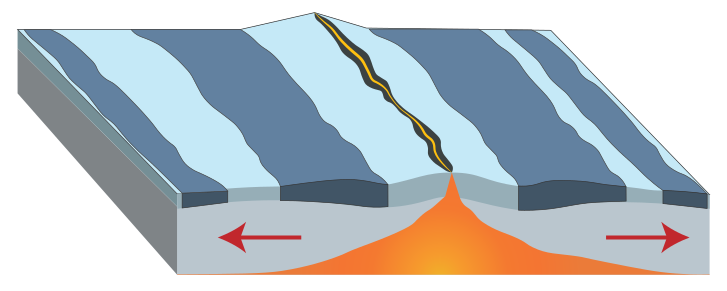
The symmetrical pattern on either side of mid-ocean ridges proves that new seafloor forms as plates separate.
- How do seismic waves help geologists understand Earth’s structure?
- They reveal where earthquakes occur next.
- They travel at different speeds through materials.
- They travel at the same speed everywhere.
- They show Earth is completely solid.
Seismic waves change speed when they travel through different materials, and some types are blocked by certain layers. P waves (primary waves) and S waves (secondary waves) travel at different speeds through rock, magma, and liquid. When S waves stop traveling at certain depths, this reveals the presence of Earth’s liquid outer core. By studying how these waves travel through the planet following earthquakes, scientists can map Earth’s internal structure, including the boundaries between the crust, mantle, outer core, and inner core.