
- What is the degree of the following polynomial?
- 4
- 5
- 9
- 3
The degree of a polynomial is the highest power of the variable that appears in the expression. The terms have exponents of 5, 3, 2, 1, and 0 (the constant term). The highest exponent is 5, so the polynomial has degree 5.
Choice A confuses the degree with the leading coefficient, and choice C confuses it with the constant term.
- What are the zeros of the following polynomial function?
- \(x = 3\:\) and \(\:x = -4\)
- \(x = -3\:\) and \(\:x = 4\)
- \(x = 6\:\) and \(\:x = -2\)
- \(x = -6\:\) and \(\:x = 2\)
The zeros of a function are the values of \(x\) where \(f(x) = 0\). Set the function equal to zero and factor:
\(x^2 – x – 12 = 0\)
Find two numbers that multiply to −12 and add to −1:
\(-4 \times 3 = -12\:\) and \(\:-4 + 3 = -1\)
\((x – 4)(x + 3) = 0\)
Setting each factor equal to zero gives \(x = 4\) and \(x = -3\).
- What is the end behavior of the following polynomial function?
- As \(x \to -\infty\), \(f(x) \to +\infty\); as \(x \to +\infty\), \(f(x) \to -\infty\)
- As \(x \to -\infty\), \(f(x) \to -\infty\); as \(x \to +\infty\), \(f(x) \to +\infty\)
- As \(x \to -\infty\), \(f(x) \to +\infty\); as \(x \to +\infty\), \(f(x) \to +\infty\)
- As \(x \to -\infty\), \(f(x) \to -\infty\); as \(x \to +\infty\), \(f(x) \to -\infty\)
End behavior is determined by the leading term, which is the term with the highest degree. Here the leading term is \(-2x^3\).
Two things matter: the degree (odd or even) and the sign of the leading coefficient (positive or negative).
- Degree is odd (3): The two ends of the graph go in opposite directions.
- Leading coefficient is negative (−2): The graph rises on the left and falls on the right.
Therefore, as \(x \to -\infty\), \(f(x) \to +\infty\), and as \(x \to +\infty\), \(f(x) \to -\infty\).
- Divide \((2x^3 + 3x^2 – 5x + 6)\) by \((x – 2)\). What is the remainder?
- 0
- 20
- 24
- −4
Use polynomial long division to divide \((2x^3 + 3x^2 – 5x + 6)\) by \((x – 2)\):
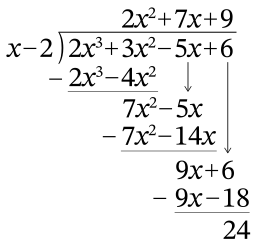
The quotient is \(2x^2 + 7x + 9\) with a remainder of 24.
- According to the rational root theorem, which of the following is a possible rational root of the polynomial below?
- \(\large{\frac{4}{3}}\)
- \(\large{\frac{2}{3}}\)
- \(\large{\frac{5}{3}}\)
- \(\large{\frac{4}{6}}\)
The rational root theorem states that any rational root \(\frac{p}{q}\) of a polynomial must have \(p\) as a factor of the constant term and \(q\) as a factor of the leading coefficient.
Here, the constant term is −6, and its factors are: ±1, ±2, ±3, ±6. The leading coefficient is 3, and its factors are: ±1, ±3.
So the possible rational roots have the form \(\frac{p}{q}\) where \(p\) divides 6 and \(q\) divides 3. Checking each choice:
- Choice A: 4 is not a factor of 6.
- Choice B: 2 is a factor of 6, and 3 is a factor of 3.
- Choice C: 5 is not a factor of 6.
- Choice D: 4 is not a factor of 6, and 6 is not a factor of 3.
- What is the maximum number of turning points for a polynomial of degree 6?
- 5
- 6
- 7
- 12
A turning point is where the graph changes from increasing to decreasing or vice versa. A polynomial of degree \(n\) has at most \(n – 1\) turning points.
For a degree 6 polynomial:
\(6 – 1 = 5\) turning points maximum
Note that the actual number of turning points could be fewer than 5, but it can never exceed 5.
- At which zero does the graph of the following function touch the \(x\)-axis without crossing it?
- \(x = -4\)
- \(x = 1\)
- \(x = 3\)
- \(x = 4\)
The behavior of a polynomial graph at each zero depends on the multiplicity of that zero, which is the number of times the corresponding factor appears.
- Odd multiplicity: The graph crosses the \(x\)-axis at that zero.
- Even multiplicity: The graph touches the \(x\)-axis and turns back without crossing.
Identify the multiplicity of each zero:
- \(x = -4\): factor \((x + 4)^2\) → multiplicity 2 (even) → touches
- \(x = 1\): factor \((x – 1)\) → multiplicity 1 (odd) → crosses
- \(x = 3\): factor \((x – 3)\) → multiplicity 1 (odd) → crosses
The only zero with even multiplicity is \(x = -4\), so that is where the graph touches without crossing. Choice D is incorrect because 4 is not a zero of this function at all.
- Which polynomial function has zeros at \(x = -1\), \(x = 2\), and \(x = 5\)?
- \(f(x) = x^3 – 6x^2 + 3x + 10\)
- \(f(x) = x^3 + 6x^2 + 3x – 10\)
- \(f(x) = x^3 – 6x^2 + 3x – 10\)
- \(f(x) = x^3 + 6x^2 – 3x – 10\)
If \(x = -1\), \(x = 2\), and \(x = 5\) are zeros, then the polynomial can be written as:
\(f(x) = (x + 1)(x – 2)(x – 5)\)
Expand step by step. First multiply the last two factors:
\((x – 2)(x – 5)\)\(\:= x^2 – 7x + 10\)
Now multiply by \((x + 1)\):
\((x + 1)(x^2 – 7x + 10)\)\(\:= x^3 – 7x^2 + 10x + x^2 – 7x + 10\)
Combine like terms:
\(= x^3 – 6x^2 + 3x + 10\)
- Find the vertical asymptote(s) of the following rational function:
- \(x = 2\:\) and \(\:x = -2\)
- \(x = 4\)
- \(x = -3\)
- \(x = 2\) only
Vertical asymptotes occur where the denominator equals zero (provided the numerator is not also zero at that point). Factor the denominator:
\(x^2 – 4 = (x + 2)(x – 2)\)
Set each factor equal to zero:
\(x + 2 = 0 \implies x = -2\)
\(x – 2 = 0 \implies x = 2\)
Check that the numerator \((x + 3)\) is not zero at either value. Since \(-2 + 3 = 1 \neq 0\) and \(2 + 3 = 5 \neq 0\), both are vertical asymptotes.
- What is the horizontal asymptote of the following rational function?
- \(y = 0\)
- \(y = \large{\frac{5}{2}}\)
- \(y = \large{\frac{2}{5}}\)
- No horizontal asymptote
To find the horizontal asymptote of a rational function, compare the degrees of the numerator and denominator:
- If the degree of the numerator is less than the denominator, the horizontal asymptote is \(y = 0\).
- If the degrees are equal, the horizontal asymptote is the ratio of the leading coefficients.
- If the degree of the numerator is greater than the denominator, there is no horizontal asymptote.
Here, both the numerator and denominator have degree 2, so the horizontal asymptote is the ratio of the leading coefficients:
\(y = \dfrac{5}{2}\)
- What is the domain of the following rational function?
- All real numbers except \(x = 9\)
- All real numbers except \(x = 3\) and \(x = -3\)
- All real numbers except \(x = 0\)
- All real numbers
The domain of a rational function is all real numbers except those that make the denominator equal to zero. Set the denominator equal to zero and solve:
\(x^2 – 9 = 0\)
\((x + 3)(x – 3) = 0\)
So \(x = 3\) and \(x = -3\) must be excluded from the domain.
Choice A sets the denominator equal to zero incorrectly as \(x = 9\), which comes from confusing \(x^2 = 9\) with \(x = 9\).
- The rational function below has a hole at which \(x\)-value?
- \(x = -2\)
- \(x = 2\)
- \(x = 4\)
- There is no hole.
A hole occurs when a factor cancels from both the numerator and denominator. Factor the numerator:
\(\dfrac{x^2 – 4}{x – 2} = \dfrac{(x + 2)(x – 2)}{x – 2}\)
The factor \((x – 2)\) appears in both, so it cancels, leaving \(f(x) = x + 2\) with a hole at \(x = 2\).
This is different from a vertical asymptote. A vertical asymptote occurs when a factor remains in the denominator after simplification, while a hole occurs when the factor cancels completely.
- Solve the following equation:
- \(x = -1\:\) and \(\:x = 6\)
- \(x = 1\:\) and \(\:x = -6\)
- \(x = 2\:\) and \(\:x = 3\)
- \(x = -2\:\) and \(\:x = -3\)
To solve a rational equation, multiply every term by the least common denominator. The LCD is \(x(x + 2)\):
\(3(x + 2) + 4x = x(x + 2)\)
Expand both sides:
\(3x + 6 + 4x = x^2 + 2x\)
\(7x + 6 = x^2 + 2x\)
Rearrange into standard form:
\(x^2 – 5x – 6 = 0\)
Factor:
\((x – 6)(x + 1) = 0\)
So \(x = 6\) or \(x = -1\). Since neither value makes a denominator zero in the original equation, both solutions are valid.
- Simplify the following rational expression:
- \(\large{\frac{x + 3}{x – 1}}\)
- \(\large{\frac{x + 3}{x + 2}}\)
- \(\large{\frac{x + 2}{x – 1}}\)
- \(\large{\frac{5x + 6}{x – 2}}\)
Factor both the numerator and denominator:
\(x^2 + 5x + 6 = (x + 2)(x + 3)\)
\(x^2 + x – 2 = (x + 2)(x – 1)\)
Write the expression in factored form:
\(\dfrac{(x + 2)(x + 3)}{(x + 2)(x – 1)}\)
Cancel the common factor \((x + 2)\):
\(= \dfrac{x + 3}{x – 1}\)
This simplification is valid for all \(x \neq -2\) and \(x \neq 1\).
- What is the horizontal asymptote of the following rational function?
- \(y = 3\)
- \(y = 0\)
- \(y = 7\)
- No horizontal asymptote
Compare the degrees of the numerator and denominator. The numerator \((3x + 7)\) has degree 1, and the denominator \((x^2 + 1)\) has degree 2.
When the degree of the numerator is less than the degree of the denominator, the horizontal asymptote is always:
\(y = 0\)
This is because as \(x\) grows very large, the denominator grows much faster than the numerator, causing the fraction to approach zero.