
- A triangle has angle measures of 40°, 60°, and 80°. Which of the following best classifies this triangle?
- Acute scalene
- Obtuse scalene
- Acute isosceles
- Right scalene
A triangle is classified by both its angles and its sides. Since all three angles are less than 90°, the triangle is acute. Since all three angles are different, all three sides have different lengths, making the triangle scalene.
Choice B is incorrect because an obtuse triangle has one angle greater than 90°. Choice C is incorrect because an isosceles triangle requires at least two equal angle measures. Choice D is incorrect because a right triangle must have exactly one 90° angle.
- Two angles of a triangle measure 53° and 74°. What is the measure of the third angle?
- 53°
- 63°
- 73°
- 127°
The interior angles of any triangle sum to 180°. Add the two known angles and subtract from 180°:
\(180° – 53° – 74° = 53°\)
Choice D is the sum of the two given angles (53° + 74° = 127°) rather than the missing third angle.
- Two interior angles of a triangle measure 38° and 65°. What is the measure of the exterior angle at the third vertex?
- 103°
- 77°
- 142°
- 90°
The exterior angle theorem states that an exterior angle of a triangle equals the sum of the two non-adjacent interior angles:
\(38° + 65° = 103°\)
Choice B (77°) is the interior angle at the third vertex, not the exterior angle. Remember, the three interior angles must sum to 180°, so the third is \(180° – 38° – 65° = 77°\). Choice C (142°) comes from subtracting only one of the remote interior angles from 180° rather than using the exterior angle theorem.
- A right triangle has legs of length 9 and 12. What is the length of the hypotenuse?
- 15
- 21
- \(\sqrt{63}\)
- \(\sqrt{21}\)
The Pythagorean theorem states that \(a^2 + b^2 = c^2\), where \(c\) is the hypotenuse. Substituting:
\(9^2 + 12^2 = 81 + 144 = 225\)
\(c = \sqrt{225} = 15\)
This is a 3-4-5 Pythagorean triple scaled by 3. Choice B adds the legs directly instead of squaring them first. Choice C subtracts the squares (\(\sqrt{144 – 81} = \sqrt{63}\)) rather than adding them. Choice D takes the square root of the sum of the legs rather than their squares.
- A 45-45-90 right triangle has legs of length 6. What is the length of the hypotenuse?
- \(6\sqrt{2}\)
- \(6\sqrt{3}\)
- 12
- \(3\sqrt{2}\)
In a 45-45-90 triangle, the hypotenuse is always \(\sqrt{2}\) times the length of either leg:
\(\text{hypotenuse} = 6\sqrt{2}\)
Choice B uses the 30-60-90 ratio (\(\sqrt{3}\)) instead of the 45-45-90 ratio (\(\sqrt{2}\)). Choice C doubles the leg length, which would only be correct in a 30-60-90 triangle where the hypotenuse is twice the shorter leg. Choice D halves the leg before multiplying by \(\sqrt{2}\), reversing the correct operation.
- In a 30-60-90 right triangle, the hypotenuse has a length of 14. What is the length of the shorter leg?
- 7
- \(7\sqrt{3}\)
- \(7\sqrt{2}\)
- 28
In a 30-60-90 triangle, the sides are in the ratio \(1 : \sqrt{3} : 2\), where the hypotenuse is twice the shorter leg. Since the hypotenuse is 14:
\(\text{shorter leg} = \dfrac{14}{2} = 7\)
Choice B is the longer leg, not the shorter. The longer leg equals the shorter leg times \(\sqrt{3}\), giving \(7\sqrt{3}\). Choice C applies the 45-45-90 ratio instead of the 30-60-90 ratio. Choice D doubles the hypotenuse rather than halving it.
- Which of the following sets of side lengths can form a triangle?
- 1, 2, 3
- 4, 5, 10
- 3, 6, 8
- 2, 3, 6
The triangle inequality theorem states that the sum of any two sides must be strictly greater than the third side. For {3, 6, 8}, all three conditions hold.
Choice A fails because \(1 + 2 = 3\), which is equal to (not greater than) the third side. Choice B fails because \(4 + 5 = 9 \lt 10\). Choice D fails because \(2 + 3 = 5 \lt 6\).
- A triangle has a base of 12 cm and a height of 7 cm. What is the area of the triangle?
- 42 cm²
- 84 cm²
- 19 cm²
- 168 cm²
The area of a triangle is \(A = \frac{1}{2}bh\). Substituting the base and height:
\(A = \dfrac{1}{2}(12)(7) = 42 \text{ cm}^2\)
Choice B omits the \(\frac{1}{2}\) factor and simply multiplies the base by the height. Choice C adds the base and height instead of multiplying them. Choice D multiplies base, height, and 2 together rather than dividing by 2.
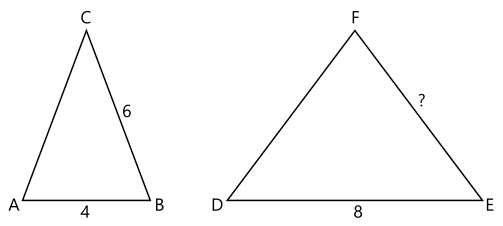
- In the diagram below, \(\triangle ABC \sim \triangle DEF\). Find \(\overline{EF}\).
- 12
- 6
- 3
- 16
Since \(\triangle ABC \sim \triangle DEF\), corresponding sides are proportional. \(\overline{DE}\) corresponds to \(\overline{AB}\), so the scale factor is:
\(\dfrac{\overline{DE}}{\overline{AB}} = \dfrac{8}{4} = 2\)
Since \(\overline{EF}\) corresponds to \(\overline{BC}\), multiply by the scale factor:
\(\overline{EF} = 6 \times 2 = 12\)
Choice B uses \(\overline{BC}\) directly without applying the scale factor. Choice C divides \(\overline{BC}\) by the scale factor rather than multiplying. Choice D scales the wrong side by the scale factor.
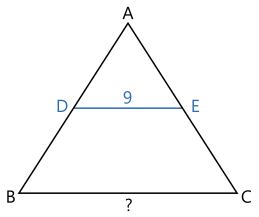
- In the diagram below, \(D\) and \(E\) are the midpoints of \(\overline{AB}\) and \(\overline{AC}\), respectively. If \(\overline{DE} = 9\), what is the length of \(\overline{BC}\)?
- 18
- 9
- 4.5
- 27
The triangle midsegment theorem states that the segment connecting the midpoints of two sides of a triangle is parallel to the third side and half its length. So \(\overline{DE} = \frac{1}{2} \cdot \overline{BC}\). Solving for \(\overline{BC}\):
\(\overline{BC} = 2 \times \overline{DE} = 2 \times 9 = 18\)
Choice B treats \(\overline{BC}\) as equal to the midsegment rather than twice its length. Choice C halves the midsegment rather than doubling it, reversing the relationship. Choice D multiplies by 3 instead of 2.
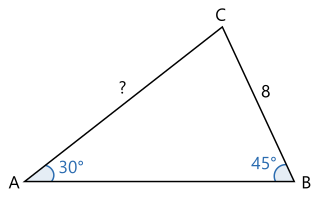
- In triangle \(ABC\), find \(\overline{AC}\) using the law of sines.
- \(8\sqrt{2}\)
- \(4\sqrt{2}\)
- \(16\sqrt{2}\)
- \(8\sqrt{3}\)
Using the law of sines, we know that \(\dfrac{BC}{\sin A} = \dfrac{AC}{\sin B}\). Substituting the known values and solving for \(\overline{AC}\):
\(\dfrac{8}{\sin 30°} = \dfrac{\overline{AC}}{\sin 45°}\)
\(\dfrac{8}{\frac{1}{2}} = \dfrac{\overline{AC}}{\frac{\sqrt{2}}{2}}\)\(\: \Rightarrow \: 16 = \dfrac{\overline{AC}}{\frac{\sqrt{2}}{2}}\)
\(\overline{AC} = 16 \cdot \dfrac{\sqrt{2}}{2} = 8\sqrt{2}\)
Choice B results from inverting the ratio by dividing \(a\) by the scale rather than multiplying. Choice D uses \(\sin 60°\) in place of \(\sin 45°\).
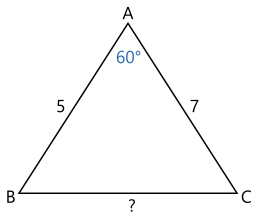
- In triangle \(ABC\), find \(\overline{BC}\) using the law of cosines.
- \(\sqrt{39}\)
- \(\sqrt{74}\)
- \(\sqrt{109}\)
- 7
The law of cosines states that \(c^2 = a^2 + b^2 – 2ab\cos C\). Here, \(c = \overline{BC}\) (the side we want), \(a = 7\), and \(b = 5\).
Substituting:
\(c^2 = 7^2 + 5^2 – 2(7)(5)\cos 60°\)
\(c^2 = 49 + 25 – 70 \cdot \dfrac{1}{2} = 74 – 35 = 39\)
\(c = \sqrt{39}\)
Choice B omits the cosine term entirely, giving only \(\sqrt{a^2 + b^2}\). Choice C adds \(2ab\cos C\) rather than subtracting it. Choice D is the value of \(a\), not \(c\).
- In triangle \(ABC\), find angle \(C\) using the Law of Cosines.
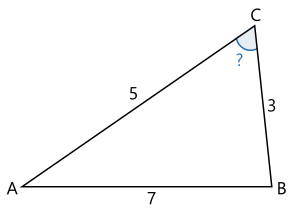
- 120°
- 60°
- 90°
- 150°
To find an angle using the Law of Cosines, use \(\cos C = \frac{a^2 + b^2 – c^2}{2ab}\). Substituting:
\(\cos C = \dfrac{3^2 + 5^2 – 7^2}{2(3)(5)} = \dfrac{9 + 25 – 49}{30} = \dfrac{-15}{30} = -\dfrac{1}{2}\)
\(C = \arccos\!\left(-\dfrac{1}{2}\right) = 120°\)
The negative value of \(\cos C\) confirms the angle is obtuse. Choice B (60°) is the reference angle. It ignores the negative sign and gives the acute angle whose cosine is \(\frac{1}{2}\). Choice C results from incorrectly assuming the triangle is a right triangle.
- A triangle has side lengths of 5, 6, and 7. Using Heron’s formula below, find the area of the triangle.
- \(6\sqrt{6}\)
- 18
- \(9\sqrt{3}\)
- \(3\sqrt{6}\)
First, find the semi-perimeter \(s\):
\(s = \dfrac{5 + 6 + 7}{2} = 9\)
Then apply Heron’s formula:
\(A = \sqrt{9(9-5)(9-6)(9-7)} = \sqrt{9 \cdot 4 \cdot 3 \cdot 2}\)\(\:= \sqrt{216} = 6\sqrt{6}\)
Choice B uses only \(s\) (the semi-perimeter) as the area, skipping the formula entirely. Choice D is half the correct answer, likely from an arithmetic error when simplifying \(\sqrt{216}\).
- A person stands 50 feet from the base of a tree and looks up at an angle of elevation of 60° to see the top. How tall is the tree?
- \(50\sqrt{3}\) ft
- \(25\sqrt{3}\) ft
- \(50\sqrt{2}\) ft
- 100 ft
The horizontal distance is adjacent to the angle and the tree height is opposite, so the tangent ratio applies:
\(\tan 60° = \dfrac{\text{height}}{50}\)
\(\text{height} = 50 \cdot \tan 60° = 50\sqrt{3} \text{ ft}\)
Choice B uses the sine ratio instead of tangent. Choice C applies a \(\sqrt{2}\) factor associated with 45° rather than 60°. Choice D results from using \(\frac{1}{\cos 60°} \times 50 = 2 \times 50 = 100\), which gives the hypotenuse (the line of sight), not the height.