


If you need help studying for the National Council for Interior Design Qualification (NCIDQ®) exam or just want some more information about what the exam is like, you’ve come to the right place.
Click below to take a free NCIDQ practice test!


What’s on the Exam?
How to Register
Exam Scores
Retaking the Exam
What Test-Takers Are Saying
FAQs
Exam Eligibility
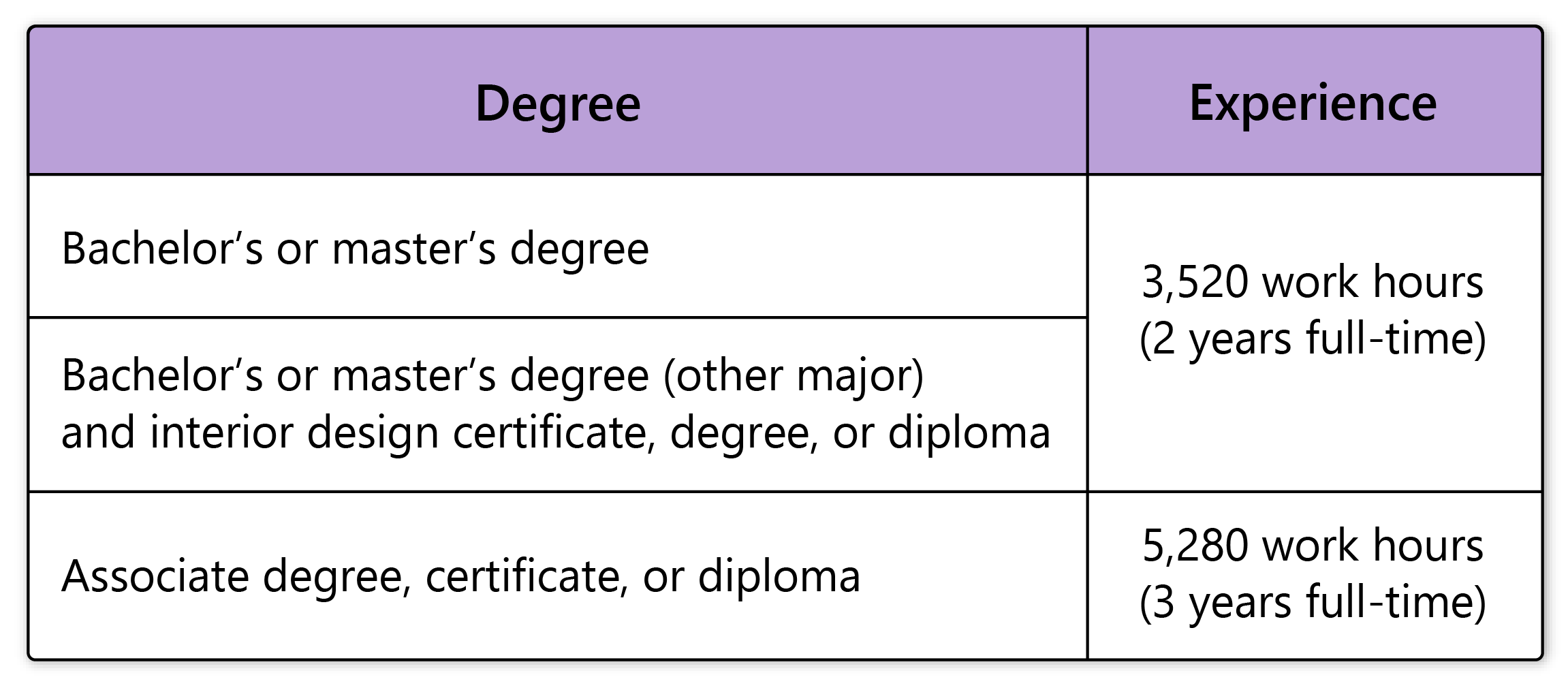
Before you can register to take the NCIDQ exam, you’ll have to meet the eligibility requirements based on your education:
Interior Design
90 quarter credit hours needed
Architecture
90 quarter credit hours needed
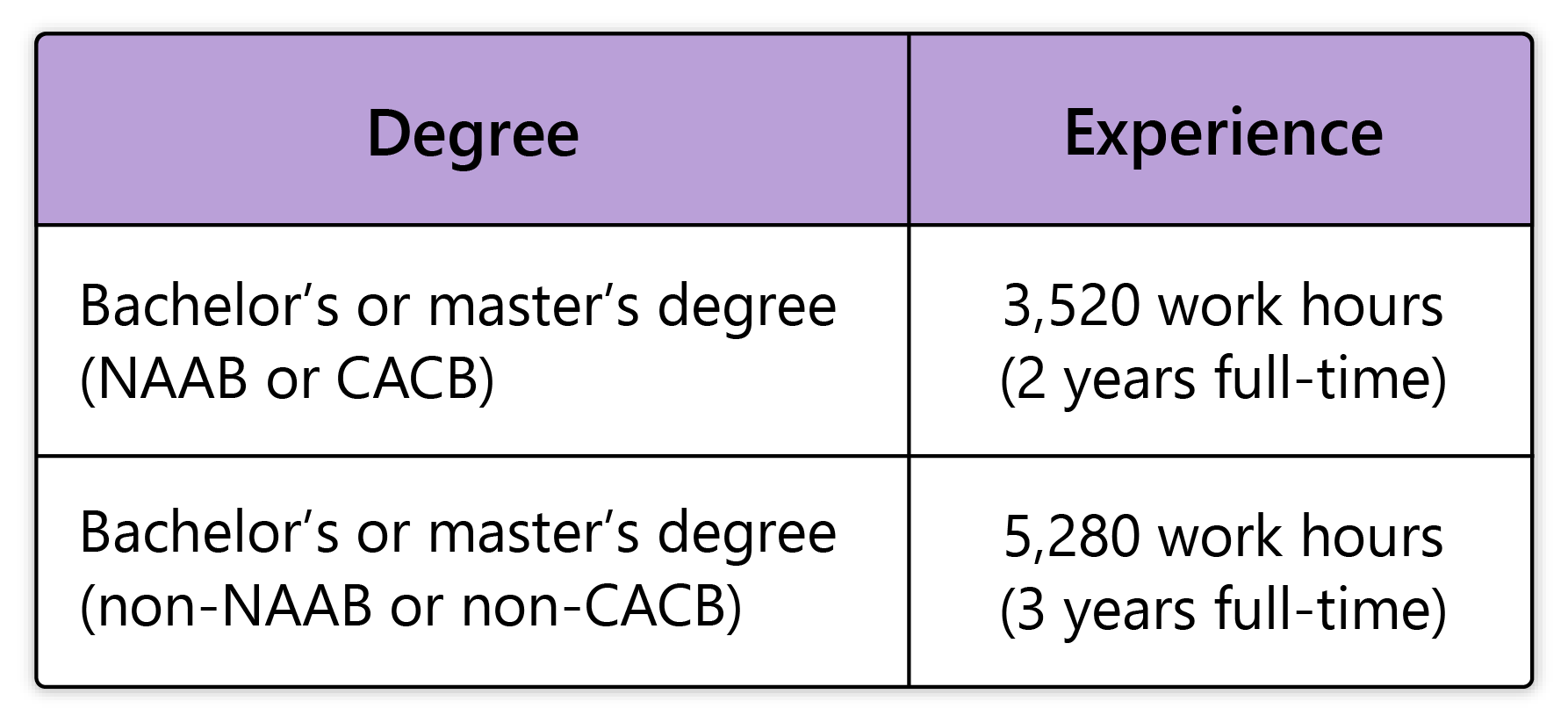
If you meet one of these requirements, you’re set to begin the registration process!
What’s on the Exam?
First, let’s talk about the questions on the exam. There are 414 questions total, but only 355 of the questions will count toward your score. Why is that?
The 59 unscored questions on the exam are called “pretest” questions. These are added to the exam to determine if they’re good enough questions to add to future versions of the test.
The trick is that you won’t have any way of knowing which questions are scored and which ones are pretest. They will appear just like the scored questions throughout the test.
The exam is split into three sections, each with their own time limit. You’ll get two optional built-in breaks during both the IDFX and IDPX sections, each break lasting 10 minutes.
Let’s take a closer look at the different sections of the exam.
Interior Design Fundamentals Exam (IDFX)
115 questions | 3 hours
- Site analysis and evaluation of existing building conditions
- Environmental, contextual, and zoning considerations
- Initial code analysis, life safety, and occupancy requirements
- Design best practices, sustainability, wellness, and universal design
- Project research, market analysis, and precedent studies
- Development of design intent, concepts, and spatial awareness
- Programming, adjacencies, circulation, and space requirements
- User needs, human factors, ergonomics, and sensory considerations
- Space planning, circulation, and spatial relationships
- Creation of preliminary drawings and graphic communication
- Selection of finishes, materials, and preliminary FF&E
- Budget, sourcing, sustainability, and feasibility considerations
- Refinement of schematic design solutions
- Design visualization, presentation methods, and wayfinding strategies
Interior Design Professional Exam (IDPX)
115 questions | 3 hours
- Project feasibility, due diligence, and evaluation of existing conditions
- Codes, zoning, occupancy types, and regulatory requirements
- Identification and coordination of project stakeholders and consultants
- Project team management, roles, and responsibilities
- Project scheduling, phasing, and resource management
- Budget development, cost estimating, and value engineering
- Procurement methods, bidding processes, and sourcing strategies
- Contract types, proposals, fee structures, and legal considerations
- Permitting processes, approvals, and jurisdictional coordination
- Construction administration, submittals, RFIs, and shop drawings
- Change management, substitutions, and documentation of revisions
- Site observation, field reports, quality control, and safety considerations
- Project close-out, commissioning, punch lists, and post-occupancy evaluation
Interior Design Implementation Exam (IDIX)
130 questions | 4 hours
- Life safety planning, egress requirements, and occupancy analysis
- Code review, material testing standards, and permit requirements
- Integration of building systems, equipment, appliances, and specialty systems
- Development of finish plans, material applications, and finish specifications
- Furniture plans, clearances, coordination, and FF&E specifications
- Construction drawings including plans, sections, elevations, and details
- Demolition plans, phasing, hazardous materials, and existing conditions
- Reflected ceiling plans, lighting layouts, controls, and energy code coordination
- Coordination of consultant drawings and technical documentation
- Power, data, low-voltage, and communication planning
- Signage and wayfinding design, including code-required signage
- Construction specifications across materials, systems, and assemblies
- Development of schedules for finishes, furniture, equipment, doors, and hardware
How to Register
Once you’ve ensured that you meet the eligibility requirements, you can register for the exam!
To get started, you’ll need to create a MyNCIDQ account and submit an application on the CDIQ website. The application will ask you for your contact information and any documentation to prove your eligibility (among other things).
When you submit the application, you’ll also need to submit the application fee, which is $235.
Once your application is approved, you’ll be able to register for each section of the exam and pay the applicable testing fees:
- IDFX: $305
- IDPX: $365
- IDIX: $470
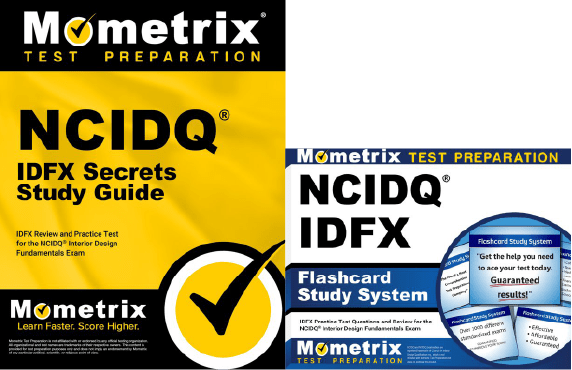
NCIDQ Study Guide and Flashcards
Get practice questions, detailed study lessons, and complex subjects broken down into easily understandable concepts.
Exam Scores
The test is scored using a scaled scoring method. Here’s how it works:
For every question you answer correctly, you get one point added to your raw score. At the end of the test, your final raw score will be converted to a scaled score. This scaled score will range somewhere between 200 and 800.
The reason your raw score is converted to a scaled score is because everyone who takes the test is given a slightly different set of questions. Since everyone has a different arrangement of questions, and because some questions are harder than others, converting your raw score to a scaled score ensures a more even playing field.
Retaking the Exam
If you didn’t get a passing score on your first try, that’s okay! You can retake the test during the next testing administration.
Keep in mind that you will have to pay the full testing fee every time you retake the test.
What Test-Takers Are Saying
Don’t just take our word for it! See what real test-takers are saying about the NCIDQ exam:
“The current version of the exam has finish calculations. This includes broadloom carpet in a room, broadloom carpet on stairs, wallpaper, wall covering, and drapery.”

juliannejpeters
“Definitely know the NFPA 701 for flame resistance of drapery. That one is always on the exam. I don’t recall ANSI standards being on the exam much at all. ASTM E84 was an important one.”

sawssie
“If you have a mixed occupancy and have to find the table, write down the multiplier for the other spaces you have. Like business is 150 gross, mercantile is 60 gross, etc. You will have to do this on every case study, so it’s helpful to have handy. For the questions where you have to mark partitions, the guide/cursor has lines that cross the entire page, so if you’re trying to find the differences, use those lines to guide you.”

LimbicSystem1379
FAQs
What does NCIDQ stand for?
NCIDQ stands for National Council for Interior Design Qualification.
How many questions are on the NCIDQ exam?
The full exam contains 360 questions total.
What is the time limit for the NCIDQ exam?
The full exam is timed at 10 hours, with each section lasting 3-4 hours.
What is the passing score for the NCIDQ exam?
You’ll need to get a final scaled score of at least 500 on each section to pass the exam.
How much does the NCIDQ exam cost?
The application fee is $235, and the exam fees vary for each section.
NCIDQ and NCIDQ Examination are registered trademarks of Council for Interior Design Qualification, Inc., which is not affiliated with Mometrix Test Preparation and does not endorse this page.