

If you need help studying for the Property and Casualty License exam or just want some more information about what the test is like, you’ve come to the right place.
Click below to take a free Property and Casualty practice test!



What's on the Exam?
Property and Casualty Sample Questions
Online Prep Course
How to Register
Exam Scores
Retaking the Exam
What is the Property and Casualty Exam?
The Property and Casualty exam is used to assess your knowledge about insurance policies related to damage or injury to people's belongings (casualty) or property. Passing this exam is a mandatory step to become a licensed agent.
Once you become an agent, you'll sell various types of insurance that covers things like homes, cars, and other valuables.
What's on the Exam?
Here's the thing: the specific details of the Property and Casualty exam will be a little different (or a lot different) depending on which state you take the exam in. Each state board issues their own time limit, number of questions, and specific topics to go on their version of the exam.
That being said, these are some of the most common topics found on Property and Casualty exams:
- Basic insurance concepts
- Types of property insurance
- Types of casualty insurance
- Underwriting and rating principles
- Handling and processing claims
- Agent ethics and professionalism
- Loss prevention and risk control
- Commercial insurance policies
- Cancellation and no-renewal procedures
Property and Casualty Sample Questions
Take this quick quiz to test your knowledge!
Property and Casualty practice questions with answers and explanations:
- Which of the following characteristics does NOT apply to an insurable loss?
- Calculable
- Measurable
- Catastrophic — Correct answer
- Unexpected
Explanation: The six characteristics of insurable loss are the following:- It must be predictable
- It must subject a large quantity of people or things to loss
- It must be accidental/unintentional loss
- It must be determinable and measurable loss
- It must be non-catastrophic loss to the insurer
- It must be a calculable/affordable premium
- The maximum amount a company will pay for a loss that occurs at a specific time and place is BEST described as:
- Per occurrence/accident limit — Correct answer
- Voluntary liability limit
- Per person limit
- Aggregate limit
Explanation: The per occurrence/accident limit is the maximum an insurance company will pay for a loss event that occurs at a specific time and place. The voluntary liability limit is the maximum amount the insurance company will pay without the company admitting to being liable. The per person limit is the maximum amount the insurance company will pay per each person involved in a claim. The aggregate limit is the maximum amount the insurance company will pay for all claims. - What condition allows a company to pursue legal action against a third party found to be at fault?
- Liberalization condition
- Concealment fraud condition
- Subrogation condition — Correct answer
- Estoppel condition
Explanation: The subrogation condition allows an insurer to pursue legal action against a third party found to be at fault. - Liam is driving when an animal jumps from the ditch hitting the side of his car and causing damage. However, the animal runs off into the woods. What coverage under Liam's personal automobile insurance policy, if purchased, would cover the damage to Liam's car?
- Comprehension coverage
- Collision coverage
- Comprehensive coverage — Correct answer
- Collider coverage
Explanation: Comprehensive coverage would cover the damage because even though Liam "collided" with the animal, collision coverage covers Liam if he "collides" with an inanimate object. A car or guardrail is considered an inanimate object because it cannot run under its own power. An animal, however, is an "animate" object, operating under its own power, so coverage would apply under comprehensive. - Insurance companies retain the right to recover the damages they paid when a third party is at fault for a loss in a process known as what?
- Subrogation — Correct answer
- Reimbursement
- Supplemental coverage
- Waiving the deductible
Explanation: Subrogation occurs when an insurance company pays for a loss that is found to be the fault of a third party and subsequently recoups the money they paid from the third party. Reimbursement means to pay something back. Supplemental coverage is for expenses incurred by the insurance company during the investigation, defense, and settlement of claims. Waiving the deductible is when the insurance company does not require the insured to pay a portion of a claim. - An insured rents a room in an owner-occupied home to a non-family member. The insured drains the pool but neglects to tell their renter. The renter runs into the backyard, does a cannon ball into the empty pool, and is injured. How will the insured's property policy deal with the bodily-injury claim?
- The insurance company will pay the bodily-injury claim and subrogate against the insured.
- The insurance company will not pay more than the maximum policy limit.
- The insurance company will only cover the bodily injury if the pool was properly fenced.
- The insurance company will offer no coverage for the bodily-injury claim. — Correct answer
Explanation: No coverage will be available for bodily injury as the third-party lives with the insured. The other three answers are not valid responses.
Online Property & Casualty Prep Course
If you want to be fully prepared, Mometrix offers an online Property & Casualty Prep Course. The course is designed to provide you with any and every resource you might want while studying. The Property & Casualty Course includes:
- 80+ Review Lessons Covering Every Topic
- Over 650 Property and Casualty Practice Questions
- 650+ Digital Flashcards
- Money-back Guarantee
- Mobile Access
The Property & Casualty Prep Course is designed to help any learner get everything they need to prepare for their Property & Casualty exam. Click below to check it out!

How to Register
Just like the other exam details, the registration process for this exam will vary slightly from state to state.
Generally, you'll need to contact your state's insurance board and fill out an application to take the exam. The testing fees will also vary for each state.
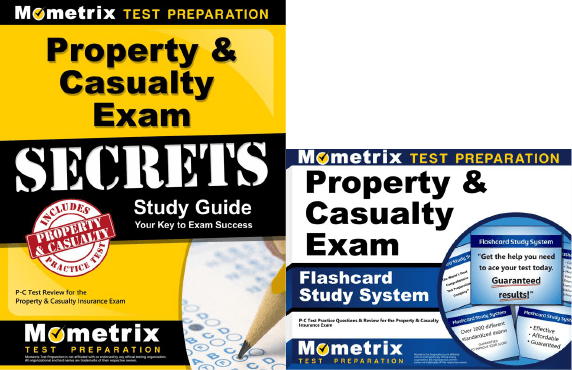
Property and Casualty Study Guide and Flashcards
Get practice questions, detailed study lessons, and complex subjects broken down into easily understandable concepts.
Exam Scores
The scoring methods for each state will vary, though most states use a scaled scoring system. This means that for every question you answer correctly, you get one point added to your raw score. At the end of the test, your final raw score will be converted to a scaled score.
The reason your raw score is converted to a scaled score is because everyone that takes the test is given a slightly different set of questions. Since everyone has a different arrangement of questions, and because some questions are harder than others, converting your raw score to a scaled score ensures a more even playing field.
The passing score requirements will also vary from state to state.
Retaking the Exam
If you didn’t get a passing score on your first try, that’s okay! Each state has its own specific rules, but most will allow you to retake the test as many times as you need.
Mometrix Test Preparation is not affiliated with or endorsed by any official testing organization. All organizational and test names are trademarks of their respective owners.