


If you need help studying for the ACT or just want some more information about what the test is like, you’ve come to the right place.
Click below to take a free ACT practice test!



What’s on the ACT?
There are 215 multiple-choice questions on the ACT, and the test is timed at 2 hours and 55 minutes.
There are four sections on the ACT (and a fifth section that’s optional!). Let’s take a closer look at each one.
ENGLISH
75 questions | 45 minutes
- Production of Writing (29%-32%)
- Knowledge of Language (15%-17%)
- Conventions of Standard English (52%-55%)
Here’s how the English section works. First, you’ll be given a passage to read. This passage will have some parts underlined and some parts labeled with numbers for easy referencing.
After you’ve read the passage, you’ll have about 15 questions to answer about the passage. Once you answer those questions, you’ll be given another passage and set of questions. There are five passages in total.
MATHEMATICS
60 questions | 60 minutes
- Preparing for Higher Math (57%-60%)
- Number and Quantity (7%-10%)
- Algebra (12%-15%)
- Functions (12%-15%)
- Geometry (12%-15%)
- Statistics and Probability (8%-12%)
- Integrating Essential Skills (40%-43%)
Here’s the good news: you are allowed to use a calculator on this section of the ACT! The math is simple enough that you shouldn’t need to use one or memorize any formulas, but you’re welcome to use a calculator if you want.
READING
40 questions | 35 minutes
- Key Idea and Details (52%-60%)
- Craft and Structure (25%-30%)
- Integration of Knowledge and Ideas (13%-23%)
This section is similar to the English section. You’ll be given some passages to read and a set of questions to answer related to each passage.
SCIENCE
40 questions | 35 minutes
- Interpretation of Data (40%-50%)
- Scientific Investigation (20%-30%)
- Evaluation of Models, Inferences, and Experimental Results (25%-35%)
- Number and Quantity (7%-10%)
- Algebra (12%-15%)
- Functions (12%-15%)
- Geometry (12%-15%)
- Statistics and Probability (8%-12%)
The science questions are geared toward students who have finished three years of high school science, including one year of biology and one year of either physical science or Earth science.
WRITING (optional)
1 essay | 40 minutes
How to Register
To get started with the registration process, you’ll need to visit the ACT website and create an account. From there, you can set up a day and time to take the test that works best for you!
Be sure to have a photo ID and a way to pay any necessary fees ready to go when you register.
ACT Scores
Once you’ve taken the test, the hard part is over! The next step is getting your final score.
You’ll actually receive multiple scores on your score report for the ACT. You’ll get a separate score for each of the four sections, ranging from 1 to 36. Those individual scores are added up to create a composite score, which is the final score that colleges and universities are interested in.
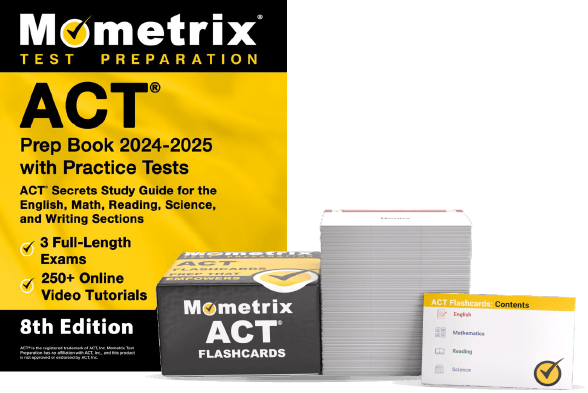
ACT Study Guide and Flashcards
Get practice questions, detailed study lessons, and complex subjects broken down into easily understandable concepts.
Retaking the Exam
If you didn’t get the score you wanted on your first try, that’s okay! You can take the ACT again to try for a higher score.
Here’s the best part: you get to choose which set of scores are sent to schools, and you can even combine scores from different test dates to create a new composite score!
Online ACT Prep Course
If you want to be fully prepared, Mometrix offers an online ACT prep course. The course is designed to provide you with any and every resource you might want while studying. The ACT course includes:
- Review Lessons Covering Every Topic
- 1,500+ ACT Practice Questions
- More than 350 Digital Flashcards
- Over 280 Instructional Videos
- Money-back Guarantee
- Free Mobile Access
- and More!
The ACT prep Course is designed to help any learner get everything they need to prepare for their ACT test. Click below to check it out!

FAQ
How long is the ACT?
The test is timed at 2 hours and 55 minutes.
How many questions are on the ACT?
There are 215 multiple-choice questions on the ACT.
What is a good composite score for the ACT?
A good composite score for the ACT is anywhere from 20 to 23.
What is the highest ACT score?
The highest score you can get is 36.