


If you need help studying for the ACT® or just want some more information about what the test is like, you’ve come to the right place.
Click below to take a free ACT practice test!



ACT Sample Questions
How to Register
ACT Scores
Retaking the Exam
Online ACT Prep Course
What Test-Takers Are Saying
FAQs
Subject Review Quizzes
What's on the ACT?
There are 171 multiple-choice questions on the ACT, and the test is timed at about 2 hours.
There are three sections on the test, plus two optional sections. Let's take a closer look at each one.
English
50 questions | 35 minutes
- Production of Writing (38%-43%)
- Knowledge of Language (18%-23%)
- Conventions of Standard English (38%-43%)
Here’s how the English section works. First, you’ll be given a passage to read. This passage will have some parts underlined and some parts labeled with numbers for easy referencing.
After you’ve read the passage, you’ll have about 10 questions to answer about the passage. Once you answer those questions, you’ll be given another passage and set of questions. There are five passages in total.
Mathematics
45 questions | 50 minutes
- Preparing for Higher Math (80%)
- Number and Quantity (10%-12%)
- Algebra (17%-20%)
- Functions (17%-20%)
- Geometry (17%-20%)
- Statistics and Probability (12%-15%)
- Integrating Essential Skills (20%)
 Don't worry—you won't have to do calculations in your head! Even though the math on the ACT doesn't require a calculator, you are allowed to use a one during the test if you'd like.
Reading
36 questions | 40 minutes
- Key Idea and Details (44%-52%)
- Craft and Structure (26%-33%)
- Integration of Knowledge and Ideas (19%-26%)
This section is similar to the English section. You’ll be given some passages to read and a set of questions to answer related to each passage.
Science (optional)
40 questions | 40 minutes
- Interpretation of Data (36%-47%)
- Scientific Investigation (17%-31%)
- Evaluation of Models, Inferences, and Experimental Results (22%-36%)
The science questions are geared toward students who have finished three years of high school science, including one year of biology and one year of either physical science or Earth science.
Writing (optional)
1 essay | 40 minutes
ACT Sample Questions
Take this quick quiz to test your knowledge!
ACT practice questions with answers and explanations:
- Which of the following would be the best replacement for the highlighted portion of the sentence below?While all dogs descend through gray wolves, it’s easy to notice that dog breeds come in a variety of shapes and sizes.
- No change
- descend by gray wolves
- descend from gray wolves — Correct answer
- descended through gray wolves
Explanation: The correct preposition here is from. The point of origin for dogs is gray wolves. Through implies a point of origin beyond gray wolves, and by implies the gray wolves are personally responsible for their descendants. - Kael is visiting another state that has a different sales tax rate than his home state. He has purchased some items that total $87.53, and his total bill came to $94.26. What was the sales tax rate on his purchase?
- 5.89%
- 6.21%
- 6.95%
- 7.69% — Correct answer
Explanation: To calculate the sales tax amount, subtract the cost of the items from the total bill:\($94.26-$87.53=$6.73\)
Then, divide the tax amount by the pretax purchase amount:\($6.73 \div $87.53=0.0769\)
To convert a decimal to a percentage, multiply by 100. To do this, simply move the decimal two places to the right to get 7.69. - If \(f(x)=4x+2\), and \(f^{-1}(x)\) is the inverse function for \(f\), then what is \(f^{-1}(6)\)?
- \(\frac{1}{2}\)
- 1 — Correct answer
- \(\frac{3}{2}\)
- 2
Explanation: If \(y=f^{-1}(6)\), then \(y\) must satisfy \(f(y)=6\). Substituting and solving for \(y\) yields \(4y+2=6\), then \(4y=4\), and \(y=1\). - What is the definition of the word haunt in the following passage?From that time forward, Mr. Utterson began to haunt the door in the by-street of shops. In the morning before office hours, at noon when business was plenty and time scarce, at night under the face of the full city Moon, by all lights and at all hours of solitude or concourse, the lawyer was to be found on his chosen post.
- To levitate
- To constantly visit — Correct answer
- To terrorize
- To daunt
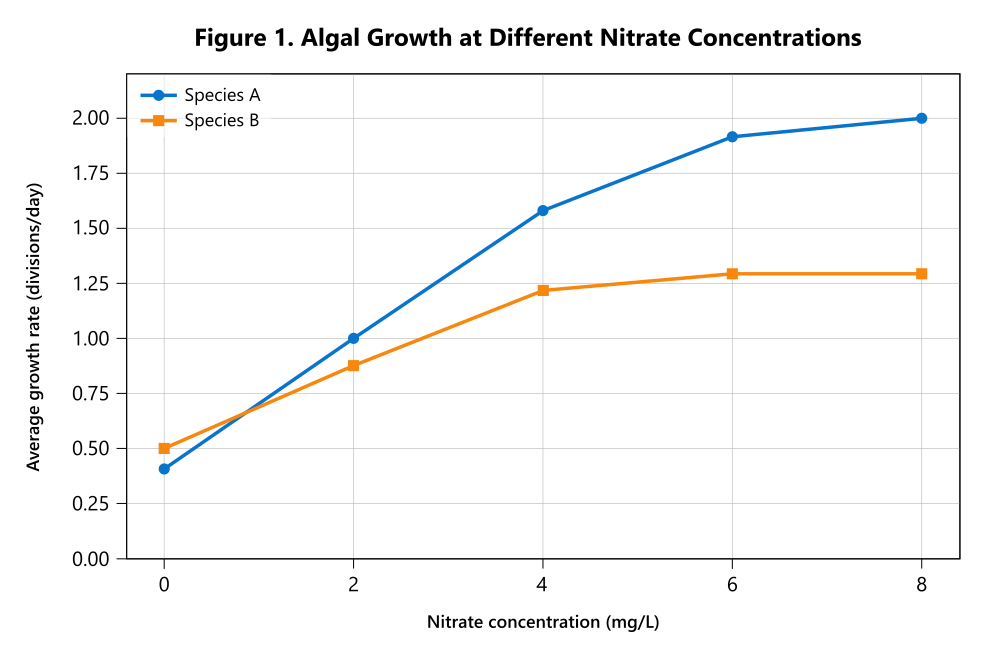
Explanation: The mention of morning, noon, and night make it clear that the word haunt refers to frequent appearances at various times. The word does not mean to levitate, terrify, or mock someone in this context. - Based on the data below, what was the lowest nitrate concentration at which the average growth rate of Species A was at least 0.5 division per day greater than that of Species B?Scientists investigated how nitrate concentration affects the growth of two freshwater algal species. They prepared culture containers containing nitrate concentrations of 0, 2, 4, 6, or 8 mg/L. Each container received the same amount of algae and was maintained under identical light, temperature, and water conditions.
After 10 days, the scientists calculated the average growth rate of each species in divisions per day. Each point in Figure 1 represents the mean growth rate from five cultures.
- 2 mg/L
- 4 mg/L
- 6 mg/L — Correct answer
- 8 mg/L
Explanation: At 4 mg/L, Species A grew at approximately 1.6 divisions per day, while Species B grew at approximately 1.2 divisions per day. The difference was only 0.4 divisions per day.
At 6 mg/L, Species A grew at approximately 1.9 divisions per day, while Species B grew at approximately 1.3 divisions per day. The difference was approximately 0.6 divisions per day. Therefore, 6 mg/L was the lowest concentration that met the condition.
How to Register
To get started with the registration process, you’ll need to visit the ACT website and create an account. From there, you can set up a day and time to take the test that works best for you!
Be sure to have a photo ID and a way to pay any necessary fees ready to go when you register.
ACT Scores
Once you’ve taken the test, the hard part is over! The next step is getting your final score.
You’ll actually receive multiple scores on your score report for the ACT. You’ll get a separate score for each of the required sections, ranging from 1 to 36. Those individual scores are added up to create a composite score, which is the final score that colleges and universities are interested in.
ACT Study Guide and Flashcards
Get practice questions, detailed study lessons, and complex subjects broken down into easily understandable concepts.
Retaking the Exam
If you didn’t get the score you wanted on your first try, that’s okay! You can take the ACT again to try for a higher score.
Here’s the best part: you get to choose which set of scores are sent to schools, and you can even combine scores from different test dates to create a new composite score!
Online ACT Prep Course
If you want to be fully prepared, Mometrix offers an online ACT prep course. The course is designed to provide you with any and every resource you might want while studying. The ACT course includes:
- 80+ Review Lessons Covering Every Topic
- Over 1,150 ACT Practice Questions
- 350+ Digital Flashcards
- 310+ Instructional Videos
- Money-back Guarantee
- Mobile Access
The ACT prep course is designed to help any learner get everything they need to prepare for their ACT test. Click below to check it out!

What Test-Takers Are Saying
Don’t just take our word for it! See what real test-takers are saying about the ACT:
“Know your grammar rules. Make sure you are an expert in commas especially, so learn every use case!”

SteelCerberus_BS
“I couldn't afford a fancy graphing calculator, so I used a regular scientific one. It has a quadratic formula solver, where you plug in \(a\), \(b\), and \(c\), and it gives you the \(x\)-values. That is probably the most useful thing you can have on the math section. It also had a \(\log (a)(x)\) solver, which also saved me a ton of time.”

black1ops22
“For the reading questions, find the questions that have a specific line reference, answer those first, then you should have enough of an idea about what the passage is about then answer the other questions.”

Yash Sharma
Quora
“The best thing you can do for the science section is to try to learn as many formulas for chemistry and physics and you can. Biology is a lot of reading and analyzing.”

AdaH
CollegeVine
FAQ
How long is the ACT?
The test is timed at about 2 hours.
How many questions are on the ACT?
There are 171 questions on the ACT.
What is a good composite score for the ACT?
A good composite score for the ACT is anywhere from 20 to 23.
What is the highest ACT score?
The highest score you can get is 36.
Subject Review Quizzes
One of the most important parts of preparing for a test is determining which topics you need to brush up on as you study.
To get started with a self-assessment of your knowledge, click on one of the subjects below!
Math
- Algebra (Basic)
- Algebra (General)
- Algebra (Intermediate)
- Algebra (Advanced)
- Averages and Rounding
- Arithmetic
- Circles
- Comparisons
- Coordinate Geometry
- Decimals
- Estimation and Sequences
- Exponential and Logarithmic Functions
- Exponents
- Factoring Polynomials
- Fractions and Square Roots
- Functions
- General Math (Basic)
- General Math (Intermediate)
- General Math (Advanced)
- Geometry 1
- Geometry 2
- Geometry 3
- Graphic Functions
- Graphs 1
- Graphs 2
- Linear Equations
- Measurement
- Order of Operations
- Percents and Ratios
- Perimeter, Area, and Volume
- Polynomial and Rational Functions
- Probability
- Quadrilaterals
- Sequences and Series
- Simplifying Expressions
- Triangles
- Trigonometric Functions
ACT® is a registered trademark belonging to ACT Education Corp. ("ACT"). ACT is not involved with or affiliated with Mometrix Media LLC, nor does ACT endorse or sponsor any of the products or services offered by Mometrix Media LLC.