

If you need help studying for the TOEFL iBT® test or just want some more information about what the test is like, you’ve come to the right place.
Click below to take a free TOEFL practice test!


What's on the TOEFL iBT?
How to Register
TOEFL Scores
What Test-Takers Are Saying
FAQs
Subject Review Quizzes
What is TOEFL?
TOEFL, which stands for Test of English as a Foreign Language, is a test used by universities to measure the English proficiency of non-native speakers.
Currently, the only available testing format is the TOEFL iBT (internet-based test). Effective January 2024, the TOEFL iBT Paper Edition test is no longer being administered.
What's on the TOEFL iBT?
There are 48 multiple-choice questions in total, along with 6 tasks, and the estimated time limit for the test is just under 2 hours.
Let's take a closer look at the four main sections of the TOEFL iBT.
Reading
2 passages
For the TOEFL Reading section, you'll be given two passages to read, each being about 700 words long. After you read each passage, you'll have 10 related questions to answer.
These are the topics covered in this section:
- Factual and negative factual information
- Inference
- Rhetorical purpose
- Vocabulary
- Sentence simplification
- Inserting a sentence into a paragraph where it makes the most sense
- Summary
Listening
5 audio clips
For the TOEFL Listening section, you'll be given a 3- to 5-minute audio clip to listen to and a set of questions to answer for each audio clip.
Three of the clips are of academic lectures, and you will be given six questions per lecture. The other two clips are of academic conversations, and you will be given five questions per conversation.
These questions are designed to test the following abilities:
- Basic listening comprehension
- Pragmatic understanding
- Connecting and synthesizing information
Speaking
4 tasks
For the TOEFL Speaking section, you'll be asked to draw on personal experience and academic content to speak about various topics.
There are four "tasks" in this section. The first task is the Independent Speaking task, which requires you to speak about a given topic using only your own personal experiences and knowledge. The other three tasks are the Integrated Speaking tasks, which require you to combine speaking with listening and/or reading to answer the questions.
For each task, you'll be given 15-30 seconds to prepare your response and 45-60 seconds to fully answer the question.
Writing
2 tasks
For the TOEFL Writing section, you'll be tasked with writing two responses to two different situations.
The first task is the Integrated Writing task, which requires you to read a short passage, listen to a discussion making additional points about the same topic, and write a short summary (150+ words) connecting the ideas presented in the passage and discussion.
The second task is the Academic Discussion task, which requires you to state and support an opinion in an online classroom discussion board.
How to Register
To get started with the registration process, you'll need to create an account on the ETS website. From there, you can register to take the test at a testing center or at home and choose the date that works best for you.
The testing fee is different depending on where you live, but you will need to pay it before you can take the test.
TOEFL Study Guide and Flashcards
Get practice questions, detailed study lessons, and complex subjects broken down into easily understandable concepts.
TOEFL Scores
Scaled Scores
The test is scored using a scaled scoring method. Here’s how it works:
For every question you answer correctly, you get one point added to your raw score. At the end of the test, your final raw score will be converted to a scaled score. This scaled score will range somewhere between 0 and 30.
The reason your raw score is converted to a scaled score is because everyone who takes the test is given a slightly different set of questions. Since everyone has a different arrangement of questions, and because some questions are harder than others, converting your raw score to a scaled score ensures a more even playing field.
Interpreting Your Scores
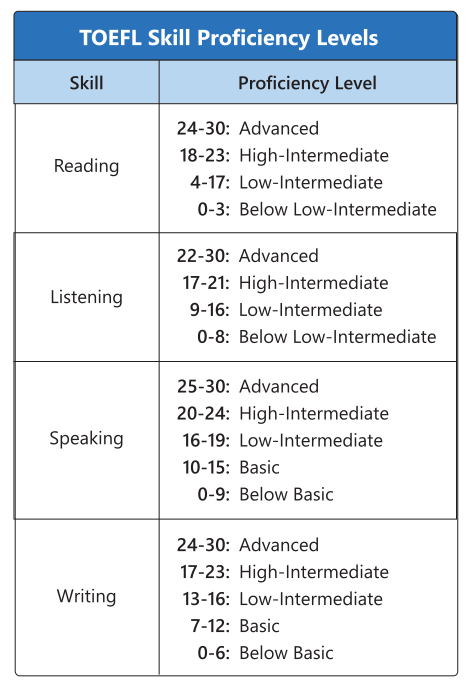
Your final score report will show you a scaled score for each section and a total scaled score between 0 and 120 for the full test. Your section scores correlate with a specific proficiency level, which gives you an idea of exactly how proficient you are in that skill.
What Test-Takers Are Saying
Don’t just take our word for it! See what real test-takers are saying about the TOEFL:
“For the reading passages, don’t waste time reading through the entire article—read what you need in order to answer the questions. You’ll be able to skip the ones you don’t know the answer to and then go back (this happens only in the reading section).”

bachiethrowaway
“Take notes during the listening section, but don’t be a robot writing down everything you hear. Questions here are not that specific, so just keep a lookout for the tone of the speaker. When you sense a mood change, write it down. Many questions ask you to describe the tone of the speaker or ask you how they felt—this is something that needs to be understood by listening carefully.”

TotalFox2
“Whilst recording, it is tempting to start again when you make a mistake. Avoid this when practicing, as you cannot start again on the day. I employed a method of adding a 'sorry' and restarting the sentence where I made the error. This allowed for correction and hopefully minimized confusion.”

Shivani219
Urch Forums
“For the independent writing task, take 2-3 minutes to plan your essay before diving in. It’s worth it. Keep it simple—don’t stress about fancy vocabulary or overly complicated grammar. Just be clear and precise.”

Prestigious-Fee9799
FAQs
What is the TOEFL test?
The TOEFL test is the Test of English as a Foreign Language, which is used by schools to evaluate the English proficiency of non-native speakers.
What is a good TOEFL score?
Each school has its own score requirements, but a final scaled score of at least 100 is generally regarded as a good score to aim for.
How long is the TOEFL test?
The estimated time given for the test is just under 2 hours.
Subject Review Quizzes
One of the most important parts of preparing for a test is determining which topics you need to brush up on as you study.
To get started with a self-assessment of your knowledge, click on one of the topics below!
TOEFL and TOEFL iBT are registered trademarks of Educational Testing Service, which is not affiliated with Mometrix Test Preparation and does not endorse this page.