

The Common Core State Standards Initiative provides shared K–12 expectations in English language arts and mathematics in order to prepared prepare students to achieve success at college and in the workforce.


What is Common Core?
This initiative was developed at the state level by government leaders and education professionals who were concerned about the lack of national standards for the education of children. However, federal incentives played a significant role in encouraging states to adopt the standards quickly.
Before the initiative, each state set its own educational requirements, which led to a situation in which some states had much lower standards than others. Not only was this unfair to the students who were being held to the lower standards, it also made it very difficult for parents, colleges, and employers to gauge the value of a high school diploma, because requirements varied so greatly.
The Common Core initiative aimed to address this problem by establishing a shared set of expectations. By 2011, 46 states had adopted the standards, along with the District of Columbia and several territories.
Since then, several states have repealed, revised, or renamed their standards, while many states continue to use standards based on or aligned with the original Common Core.
Practice Questions
To get a feel for what sort of questions and topics you’ll find in each grade level, check out the free practice questions listed below!
English Language Arts
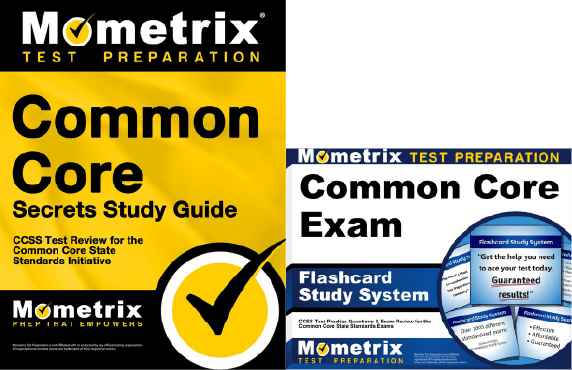
Common Core Study Guide and Flashcards
Get practice questions, detailed study lessons, and complex subjects broken down into easily understandable concepts.
How the Standards Work
Structure and Flexibility
The standards are divided into two main categories: Mathematics and English Language Arts. These two subjects were chosen because they are the foundations upon which students build to master all other subjects. In each category, the standards are provided for every level, from kindergarten to 12th grade.
These standards set specific goals, but it's up to the administrators and teachers in each school to determine the best methods of achieving those goals. Teachers have the flexibility and autonomy to give their students a great education while having clear outcomes to aim for. The standards provide guidance without dictating how classrooms are run.
This also means that education programs at colleges and universities will be better able to train future teachers. Educational publishers will have benchmarks to guide them in developing textbooks and other educational materials, and testing will be more effective with uniform, clear-cut standards across the board.
Assessment and Preparation
Students may be assessed through state or district tests that measure progress toward grade-level standards. While teachers will play a key role in helping students gain the skills and knowledge required by these standards, it will be up to the student to actually pass the exams.
The practice questions above can help students identify strengths and weaknesses before taking standards-based assessments.
Subject Review Quizzes
One of the most important parts of preparing for a test is determining which topics you need to brush up on as you study.
To get started with a self-assessment of your knowledge, click on one of the topics below!
Math
- Linear Equations
- Math (Basic)
- Math (Intermediate)
- Math (Advanced)
- Measurement
- Number and Quantity
- Percents and Ratios
- Perimeter, Area, and Volume
- Polynomial and Rational Functions
- Quadratic Equations
- Quadrilaterals
- Radical Expressions
- Rational Expressions
- Sequences and Series
- Statistics and Probability
- Systems of Equations
- Triangles