


If you’re looking to practice for the GED®, you’ve come to the right place!
Click below to take a free GED practice test.



GED Test Outline
GED Sample Questions
GED Online Prep Course
Subject Review Quizzes
Subject-Specific GED Practice Tests
If you need some extra practice in a specific subject, click one of the subjects below to get started on a subject-specific GED practice test.




GED Test Outline
Here's a quick look at the four sections of the GED:
- Mathematical Reasoning
- Reasoning Through Language Arts
- Social Studies
- Science
You'll have to take and pass all four sections to get your GED, but you can space them out and take them one by one if you want.
Click below for a full breakdown of the GED test:
GED Sample Questions
Take this quick quiz to test your knowledge!
GED practice questions with answers and explanations:
- What is the meaning of the word elusive in the following paragraph?There was something coming to her and she was waiting for it, fearfully. What was it? She did not know; it was too subtle and elusive to name. But she felt it, creeping out of the sky, reaching toward her through the sounds, the scents, the color that filled the air.
- Horrible
- Indefinable — Correct answer
- Quiet
- Joyful
Explanation: The word elusive most closely means "indefinable." - 6 is 30% of what number?
- 18
- 20 — Correct answer
- 24
- 26
Explanation: We can rewrite 30% as \(\frac{3}{10}\), so we can say that \(6=(\frac{3}{10})n\), where \(n\) is the unknown number.
To solve, we can multiply both sides by the reciprocal fraction, \(\frac{10}{3}\):\(n=\dfrac{10}{3}\times 6=\dfrac{60}{3}=20\)
- If Damian takes 48 minutes to walk three miles, how long should it take him to walk five miles maintaining the same speed?
- 32 minutes
- 64 minutes
- 80 minutes — Correct answer
- 96 minutes
Explanation: To solve the problem, we can write a proportion consisting of ratios comparing distance and time. One way to set up the proportion is:\(\dfrac{3}{48} = \dfrac{5}{x}\)
Here, \(x\) represents the unknown value of time. To solve this proportion, we can cross-multiply:\((3)(x)=(5)(48)\:\:\) or \(\:\:3x=240\)
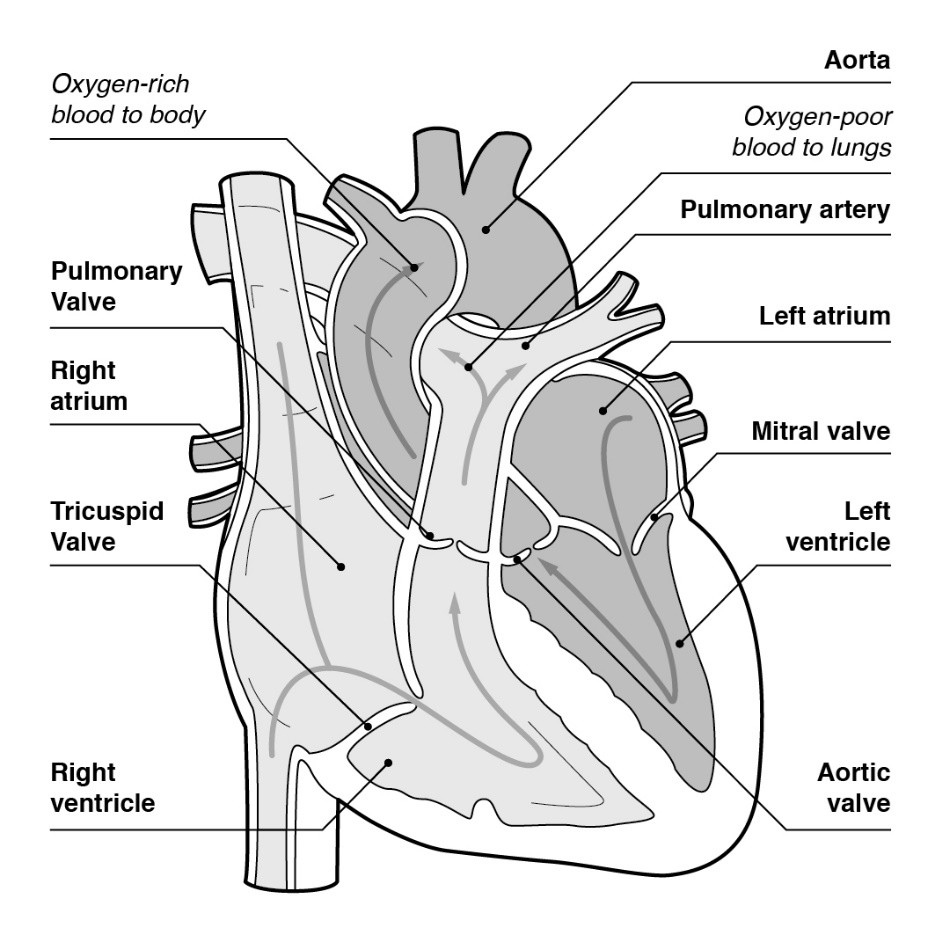
To isolate the variable, we divide by 3 on both sides, getting \(x=80\). - Looking at the data below, which is the final chamber that the blood flows through before entering the aorta?The heart is a muscle that is responsible for pumping blood through the body. It is divided into four chambers: the right atrium, right ventricle, left atrium, and left ventricle. Blood enters the atria and is then pumped into the ventricles below them. There is a valve between the atria and ventricles that prevents the blood from flowing back into the atria. The valve between the right atrium and ventricle has three folds whereas the valve between the left atrium and ventricle has two folds.
Arteries carry oxygen-rich blood away from the heart to the body. Veins carry oxygen-poor blood from the body back to the heart. From there, the blood gets pumped to the lungs to get re-oxygenated and then back to the heart before circulating to the body. The heart beats every second of the day. For an adult, the normal heartrate is between 60 and 100 beats per minute. For a child, a normal heartrate is between 90 and 120 beats per minute.

- Right ventricle
- Left ventricle — Correct answer
- Right atrium
- Left atrium
Explanation: Looking at the diagram and following the arrow in the aorta backwards, the left ventricle is where the blood is coming from directly before it enters the aorta. Blood flows from the atria to the ventricles, so it enters the left atrium, Choice D, before the left ventricle. Oxygen-poor blood is on the right side of the heart and flows from the right atrium to the right ventricle before flowing to the lungs to get re-oxygenated, Choices A and C. - Based on the information below, which item has an elastic demand?One common feature of all elastic products is the availability of substitutes. A substitute is a good or service that can be used as an alternative to a good or service. Although the products may differ slightly, they ultimately can be used to accomplish similar things. If there is a significant amount of goods or services that can be substituted for a good or service, it has an elastic demand. This means a small increase in price results in a significant decrease in the quantity demanded. If there are only a few or no substitutes, the product has an inelastic demand. The price can increase without causing a significant decrease in demand.
- Gasoline
- Tobacco
- Salt
- Beef — Correct answer
Explanation: Beef has an elastic demand because it can be substituted with other types of meat, such as pork or chicken, if its price goes up. Choice A, gasoline, is a product that has an inelastic demand. Because most cars, small lawn mowers, and airplanes, run solely on gasoline, the price can be increased and it will not have a significant decrease in demand. Tobacco is another product that does not have a substitute and has an inelastic demand. There is not a good replacement for salt, so this item is inelastic as well.
Online GED Prep Course
If you want to be fully prepared, Mometrix offers an online GED prep course. The course is designed to provide you with any and every resource you might want while studying. The GED course includes:
- 90+ Review Lessons Covering Every Topic
- Over 2,100 GED Practice Questions
- 300+ Digital Flashcards
- 400+ Instructional Videos
- Money-back Guarantee
- Mobile Access
The GED prep course is designed to help any learner get everything they need to prepare for their GED exam. Click below to check it out!

Subject Review Quizzes
One of the most important parts of preparing for a test is determining which topics you need to brush up on as you study.
To get started with a self-assessment of your knowledge, click on one of the subjects below!
Math
English
GED® is a registered trademark of the American Council on Education (ACE) and administered exclusively by GED Testing Service LLC under license. This material is not endorsed or approved by ACE or GED Testing Service.