


If you need help studying for the MCAT® exam or just want some more information about what the test is like, you’ve come to the right place.
Click below to take a free MCAT practice test!


How to Register
MCAT Scores
Retaking the MCAT
What Test-Takers Are Saying
FAQs
Subject Review Quizzes
What's on the MCAT?
There are 230 multiple-choice questions on the exam, and the time limit is 6 hours and 15 minutes. It’s a long test, but don’t worry! There are two 10-minute breaks and one 30-minute break to take advantage of.
Let’s take a closer look at the different sections of the MCAT exam.
Biological and Biochemical Foundations of Living Systems
59 questions
This section covers four main science-based disciplines:
- • Basic biochemistry
25% - • Basic biology
65% - • General chemistry
5% - • Organic chemistry
5%
Chemical and Physical Foundations of Biological Systems
59 questions
This section covers five main science-based disciplines:
- • Basic biochemistry
25% - • Basic biology
5% - • General chemistry
30% - • Organic chemistry
15% - • Basic physics
25%
Psychological, Social, and Biological Foundations of Behavior
59 questions
This section covers three main science-based disciplines:
- • Basic psychology
65% - • Basic sociology
30% - • Basic biology
5%
Critical Analysis and Reasoning Skills
53 questions
This section covers three main science-based disciplines:
- • Foundations of comprehension
30% - • Reasoning within the text
30% - • Reasoning beyond the text
40%
How to Register
To get started, you’ll need to create an account on the AAMC website. Once you’ve made your account, you’ll be able to register for the exam and choose a testing date and location.
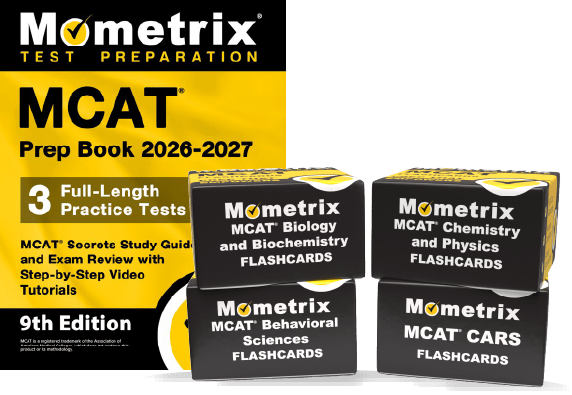
MCAT Study Guide and Flashcards
Get practice questions, detailed study lessons, and complex subjects broken down into easily understandable concepts.
MCAT Test Scores
Once you have completed the test, the hard part is over! The next step is waiting for your score report, which will be released in 30-35 days.
The MCAT exam is scored using a scaled scoring method.For every question you answer correctly, you get one point added to your raw score. At the end of the test, your final raw score will be converted to a scaled score ranging from 472 to 528.
The reason your raw score is converted to a scaled score is because everyone who takes the MCAT test is given a slightly different set of questions. Since everyone has a different arrangement of questions, and because some questions are harder than others, converting your raw score to a scaled score ensures a more even playing field.
One of the perks of the MCAT is that there is technically no way to "fail” the test! How is that possible? Well, because your MCAT scores are used by schools as an evaluation tool, there is no predetermined passing score to achieve. Different nursing programs will be looking for different MCAT scores, so what counts as “passing” is totally up to those programs.
Retaking the MCAT
If you didn’t get the score you wanted on your first try, that’s okay! You can retake the test up to three times per year.
Here’s the catch—you can only take the exam seven times. That’s it. After your seventh attempt, you will not be able to take the MCAT ever again.
What Test-Takers Are Saying
Don’t just take our word for it! See what real test-takers are saying about the MCAT:
“Having amino acids be muscle memory is key (things like knowing R groups, knowing hydrophobic vs. neutral). Same for the Krebs cycle (molecular structures, enzymes, energy yields). Also, you should know every irreversible step of Krebs and glycolysis—they like to test on those.”

leadbunny
“The questions are often ambiguous, and I often felt unsure on a lot of questions. Definitely look at the logic and justification of each of the questions, as there are a lot of patterns in logic and thinking. The passage is vital most of the time, and it is worthwhile to take extra time reading it over.”

MassiveShoe7894
“The process of elimination is essential in the psychological section, as you will often get questions that require you to know four different theories—even if one is something you have no clue about, you may be able to eliminate the other options.”

Spartan10142
FAQs
How long is the MCAT?
The time limit for the exam is 6 hours and 15 minutes, but you will spend about 7.5 hours at the testing center.
What is the MCAT?
The MCAT is a standardized exam that is required for admission to medical schools in the United States and Canada.
What is a good MCAT score?
While there’s no universal passing score for the MCAT, a good MCAT score is considered to be 511.
How many times can you take the MCAT?
You can only take the MCAT seven times.
What does MCAT stand for?
MCAT stands for Medical College Admission Test.
How hard is the MCAT?
The MCAT is considered to be a pretty difficult exam. There are a few reasons for this, but the main reason is the extensive amount of factual knowledge and analytical skills needed to answer many of the questions.
How many questions are on the MCAT?
The exam contains 230 multiple-choice questions.
How much is the MCAT?
The testing fee for the MCAT is $355.
Subject Review Quizzes
One of the most important parts of preparing for a test is determining which topics you need to brush up on as you study.
To get started with a self-assessment of your knowledge, click on one of the subjects below!
Biology
MCAT is a registered trademark of the Association of American Medical Colleges, which does not endorse this page or its methodology.